Broadleaf Commerce vs commercetools
commercetools is a powerful API-first platform, but it ships without a frontend, without an admin console, and without out-of-the-box business user tooling. Broadleaf Commerce delivers source-available extensibility and a complete, customizable platform without the assembly requirement.
How do they stack up?
Both platforms are built for enterprise commerce teams that want architectural control. The difference is how much your team has to build before the platform is usable, and how much access you have once it is.

- Source-available codebase, full access at every layer
- Built-in fully customizable React-based admin console
- Built-in frontend tooling, no custom UI development required to operate
- Native B2B and B2C in one platform
- Deploy on AWS, Azure, GCP, or on-premise
- Dedicated PaaS, single-tenant
- Hierarchical multi-brand catalog management
- Predictable licensing, not consumption based
- 99% CSAT, 10+ years

- Closed codebase, API-layer extensibility only
- No built-in admin console, custom development required
- No built-in frontend or business user tooling, custom development required to operate
- B2B capabilities available but configuration intensive
- commercetools-controlled cloud infrastructure
- Multi-tenant SaaS
- Multi-site management available, significant configuration required
- Consumption and usage-based pricing, not publicly disclosed
Why Switch to
Broadleaf Commerce?
-
A Platform Your Business Users Can Actually Operate
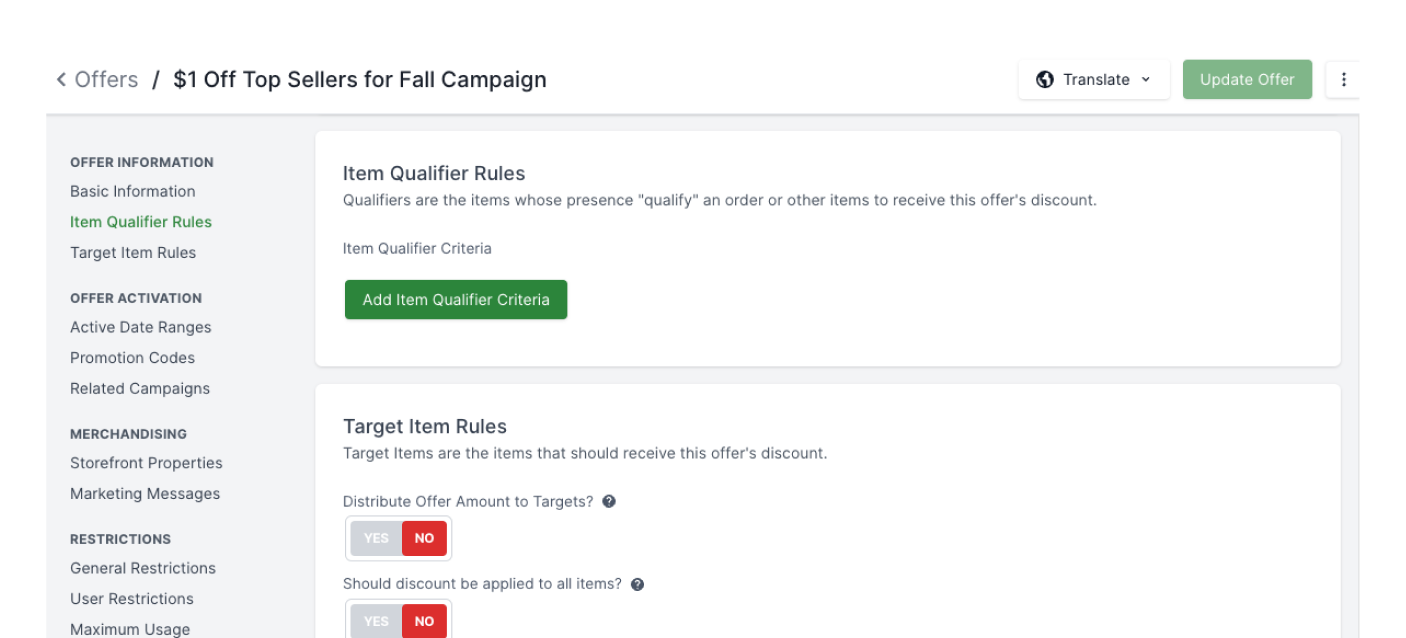
commercetools ships with no built-in admin console, no merchandising UI, and no business user tooling. Every screen your operations team needs to manage pricing, promotions, catalog, and content requires custom front-end development. Broadleaf's fully customizable React-based admin console is included out of the box and designed to be tailored to your team's exact workflows, giving business users direct control without opening a development ticket for routine operations.
-
Source-Available vs. Closed API
commercetools' codebase is closed, limiting your team to the API layer. Complex customizations, custom data models, and deeply tailored business logic require working within the boundaries commercetools exposes. Broadleaf's source-available codebase gives your team full access at the data, microservice, API, and admin layers, enabling customizations that are genuinely yours with no platform ceiling.
-
Complete Platform vs. Assembly Required
commercetools is explicit about what it is: an API-first set of commerce services that requires a frontend, an admin interface, and significant integration work before it functions as a complete commerce platform. According to reviewers on G2 and Gartner Peer Insights, that assembly typically requires substantial SI involvement and extended implementation timelines. Broadleaf delivers a complete platform out of the box, with source-available extensibility for the teams that want to go deeper.
-
Purpose-Built B2B Commerce
Broadleaf's B2B capabilities, including quoting, bulk ordering, contract pricing, account hierarchies, dealer portals, approval workflows, and self-serve buyer portals, are built into the core platform and surfaced through a customizable admin console. commercetools' B2B capabilities are real but reviewers consistently note the complexity of configuring them for demanding enterprise use cases without significant custom development.
-
Deployment Flexibility
commercetools runs on commercetools-controlled cloud infrastructure. Broadleaf gives you a genuine choice: deploy on AWS, Azure, GCP, on-premise, or fully managed through Broadleaf Cloud, with only your business as a tenant. Your infrastructure strategy is yours to own, including data residency requirements and compliance obligations.
-
Predictable Licensing vs. Consumption-Based Pricing
commercetools does not publicly disclose its pricing. Based on third-party sources and user reviews, commercetools pricing is consumption and usage based, meaning your platform costs scale with your API call volume, order volume, and business growth. Broadleaf's licensing is predictable and never tied to your usage, transaction volume, or revenue performance.
-
Built for Multi-Brand and Multi-Site Complexity
Broadleaf's Hierarchical Data Management supports shared parent catalogs that push updates across every brand and site automatically, with site-level overrides for regional pricing and product variations, proven at scale with customers customers managing thousands of global sites. commercetools supports multi-site management but requires significant configuration and custom development to achieve the same level of catalog inheritance and business user accessibility.
-
Unmatched Support, Trusted for Over a Decade
Client support with a 99% customer satisfaction rating for 10+ years, and a team that built (not bought) the platform. When something needs to be fixed, you talk to the people who know the code, not an internal ticket queue or a consultant who has moved on to the next project.