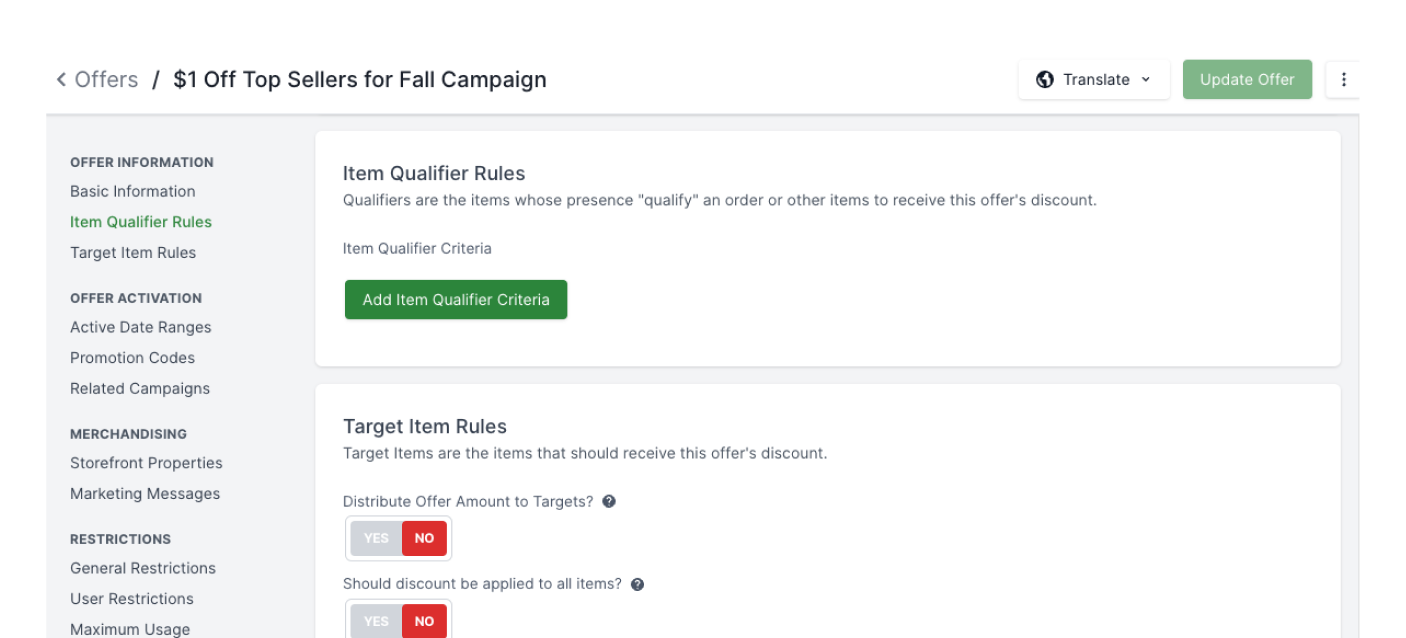
Broadleaf Commerce vs Oracle Commerce Cloud
Oracle ATG reached end of life in May 2022 with no path to security patches or updates. Oracle Commerce Cloud pricing scales directly with your page views and order volume. Broadleaf Commerce offers a modern composable path forward: Java and Spring Boot microservices, licensing never tied to your traffic or transaction volume, and active product investment from a team fully dedicated to commerce.
How do they stack up?
For enterprise teams still running Oracle ATG or evaluating Oracle Commerce Cloud, here is how Broadleaf Commerce compares across architecture, licensing, deployment, and long-term platform investment.

- Java and Spring Boot microservices architecture built for enterprise complexity and long-term extensibility
- Perpetual and subscription licensing options, never tied to page views, order volume, or commerce revenue
- True microservices architecture where individual components are independently deployable and replaceable
- Source-available codebase with extensibility at domain, service, and API levels
- Deploy on AWS, Azure, GCP, your own cloud, or on-premise, with fully managed Broadleaf Cloud available as an option
- Hierarchical Data Management built natively for multi-site, multi-brand, and multi-region complexity
- Purpose-built B2B commerce including quoting, contract pricing, account hierarchies, dealer portals, and approval workflows built into the core platform
- Native marketplace architecture with vendor management built into the core platform
- Fully customizable React-based admin console tailored to your team’s workflows
- PaaS with only your business as a tenant
- Active product investment and roadmap with a team fully dedicated to commerce
- ATG reached end of life May 2022, no Premier Support available
- OCC pricing based on page views and order volume, costs grow with traffic
- ATG monolith carrying decades of customization debt, no path to updates
- Proprietary codebase, Oracle-certified expertise and SI dependency required
- OCC deployment controlled by Oracle, limited infrastructure flexibility
- Multi-site management available, significant configuration required for catalog inheritance
- B2B most powerful within broader Oracle CX ecosystem
- Marketplace requires third-party tools or custom development
- OCC admin usability receives mixed reviews from business users
- OCC is multi-tenant SaaS with limited product investment
Why Switch to
Broadleaf Commerce?
-
ATG Is End of Life. The Clock Has Been Running Since 2022.
Oracle ATG Commerce reached end of life in May 2022. No new security patches, no updates, no certifications for new third-party products. According to Oracle's published support lifecycle documentation, no versions of Oracle Commerce currently qualify for Oracle Premier Support. Every day you remain on ATG is an accumulating security and compliance risk that third-party support vendors can extend but cannot resolve. The question is no longer whether to move. It is where to land.
-
OCC Pricing Grows With Your Success
Oracle Commerce Cloud Standard tier pricing starts at $20 per 1,000 page views annually at Oracle's published list rates, with minimums that put entry-level commitments well into six figures before negotiation. As your traffic and transaction volume grow, your Oracle costs grow with them. Broadleaf's perpetual and subscription licensing models are never tied to your traffic, page views, or order volume. Your platform costs stay predictable regardless of how fast your business scales.
-
Java Architecture Without the Oracle Overhead
Both Broadleaf and Oracle ATG are Java-based platforms, so your existing development team's skills transfer directly. ATG carries decades of legacy overhead with no active maintenance path. OCC is built on pieces of legacy Oracle technology that reviewers consistently describe as complex and requiring skilled developers to unlock. Broadleaf's microservices architecture built on Spring Boot is modern, modular, and designed for teams that want to move fast without being blocked by platform complexity or Oracle ecosystem dependency.
-
Commerce Is a Small Part of a Very Large Oracle Portfolio
Oracle is one of the largest enterprise software companies in the world. Commerce is a fraction of their product portfolio, competing internally for roadmap investment against ERP, database, cloud infrastructure, and dozens of other product lines. Industry analysts and customers have consistently noted the relative lack of innovation on Oracle Commerce Cloud compared to dedicated commerce platforms. Broadleaf is a commerce-first company with a single product and a team fully committed to it.
-
Escape the Oracle Ecosystem Dependency
Oracle Commerce Cloud is designed to deliver maximum value when you are running Oracle ERP, Oracle CPQ, and the broader Oracle CX suite. The more deeply you integrate with Oracle's ecosystem, the harder it becomes to replace any individual component. Broadleaf integrates with Oracle ERP where that connection has business value, but your commerce platform is not architecturally dependent on staying inside the Oracle ecosystem.
-
B2B Commerce Without the Oracle Stack
Oracle Commerce Cloud's B2B capabilities are real, but they are most powerful and most costly to implement when tightly coupled with Oracle ERP and Oracle CX. Broadleaf's native B2B capabilities, including quoting, contract pricing, account hierarchies, dealer portals, and approval workflows, work independently of your ERP choice and are available without deep Oracle ecosystem dependency.
-
Built for Multi-Brand and Multi-Site Complexity
Broadleaf's Hierarchical Data Management supports shared parent catalogs that push updates across every brand and site automatically, with site-level overrides for regional pricing and product variations, proven at scale with customers managing 30 global sites. Oracle Commerce Cloud supports multi-site management but requires significant configuration and SI involvement to achieve true catalog inheritance across complex brand and regional structures.
-
Unmatched Support, Trusted for Over a Decade
Client support with a 99% customer satisfaction rating for 10+ years, and a team that built (not bought) the platform. When something needs to be fixed, you talk to the people who know the code, not an internal ticket queue or a consultant who has moved on to the next project.