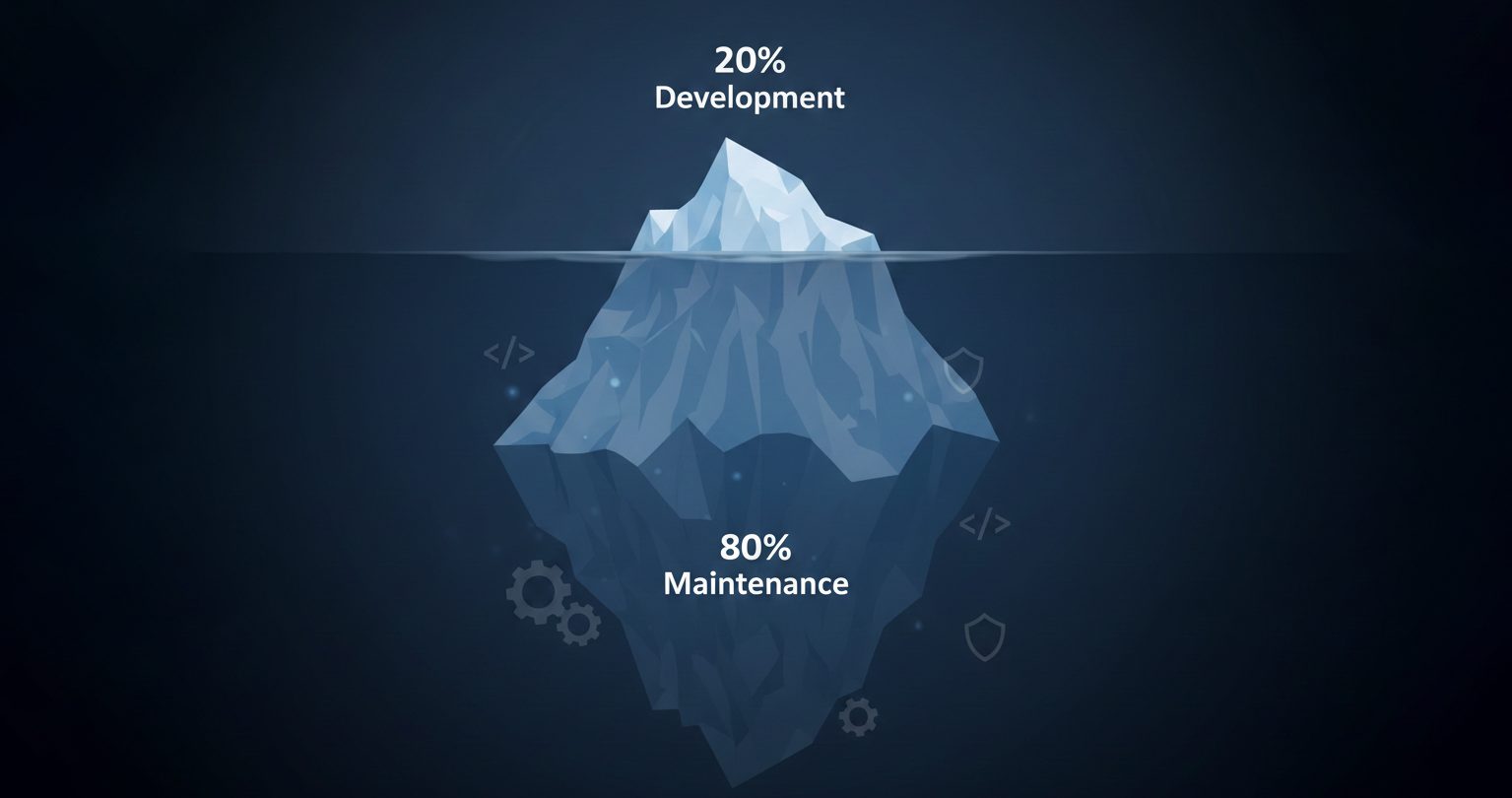
Traditional operations teams spend 41% more time on infrastructure management overall, with 21% more time putting out fires compared to DevOps-enabled teams. For enterprise commerce teams running microservices, this translates to your most expensive Java developers wrestling with Kubernetes configurations, database replication strategies, and CI/CD pipeline debugging instead of optimizing checkout flows or building innovative commerce features. This is the hidden cost of cloud-native architecture, bleeding engineering capacity from the work that actually differentiates your business.
Microservices and cloud-native deployment offer genuine advantages for enterprise commerce: unprecedented scalability, flexibility, and the architectural freedom that Chief Architects and lead developers need to solve complex problems. But that freedom comes with a price. Building, securing, maintaining, and observing a distributed commerce ecosystem demands substantial DevOps and SRE effort. The operational burden is real, and it's expensive in both budget and engineering focus.
At Broadleaf Commerce, we built our microservice architecture specifically to empower enterprise teams, providing the tools and flexibility to tackle the most complex commerce challenges, especially those in the Java and Spring ecosystem. But we recognized that offering a powerful, modular platform was only half the battle. The other half is ensuring the platform can be effortlessly deployed, operated, and scaled without becoming an organizational burden.
This is why we built Broadleaf Cloud: a fully managed, dedicated Platform-as-a-Service solution tailored specifically for Broadleaf Commerce applications. It reclaims engineering time from undifferentiated operational work and redirects that expertise toward building unique commerce functionality that directly impacts your bottom line.
The Operational Overhead of Cloud-Native Commerce
Adopting a microservices architecture is a strategic decision that trades monolithic simplicity for distributed complexity. For the savvy technical team, the complexity is worth the architectural gain, but the cost of ownership is real.
When running Broadleaf microservices (or any Spring Boot/Java microservices) on a public cloud, your team immediately becomes responsible for a host of non-core-commerce operational tasks:
Infrastructure Lifecycle: Provisioning, patching, and maintaining the underlying Kubernetes clusters and nodes.
Data Tier Management: Handling database provisioning, replication, backup, and patching across multiple environments.
Network and Ingress: Configuring virtual networks, load balancers, and ingress controllers to ensure traffic is securely and reliably routed to the correct microservice.
Observability Stack: Implementing and maintaining a comprehensive logging, monitoring, and tracing solution is an absolute necessity for diagnosing issues in a distributed system.
Security and Compliance: Enforcing security policies at the network level, managing secrets, applying security patches, performing audit logging and monitoring, integrating with SIEM tools, and maintaining compliance standards like PCI DSS.
CI/CD Pipeline: Developing and maintaining automated pipelines for continuous testing, deployment, and rollback across multiple environments.
Each of these tasks requires specialized skills and diverts critical engineering resources away from enhancing the commerce platform itself. Broadleaf Cloud eliminates this operational work, handling the infrastructure lifecycle so your team can focus exclusively on commerce functionality.
What We Manage vs. What You Control
Broadleaf Cloud is a partnership rooted in a shared responsibility model. We take on the operational complexity that doesn't differentiate your business, freeing up your team to focus on the core business logic that is unique to your company.
Broadleaf Manages the Infrastructure Foundation
We handle the complete provisioning and maintenance of your dedicated Kubernetes cluster and underlying infrastructure. This includes a fully integrated CI/CD pipeline with dedicated repositories for Maven, NPM, and Docker, enabling automated deployment across isolated environments for development, QA, and production.
Security and compliance are built into the foundation, not bolted on afterward. We provide unlimited security and code evaluations using integrated DAST, SAST, SCA, and open-source license governance tooling. This includes foundational security measures, automated updates, network isolation, and a secure-by-default environment optimized specifically for Broadleaf applications.
Visibility into your system's health comes standard through a full observability stack with application performance monitoring and log aggregation.. This is paired with 24/7 support and a dedicated Technical Account Manager who knows your implementation. For business continuity, we maintain a high availability Kubernetes architecture with Active/Passive Disaster Recovery.
Your Team Retains Strategic Control
The application code and business logic remain entirely in your hands. This is your core intellectual property, the custom features that differentiate your business in the market. You decide how your microservices are composed and deployed using Broadleaf's Flex Packages, giving you architectural flexibility without infrastructure complexity.
Ownership of the data model structure, third-party integrations, and performance optimization choices stays with your architecture team. You maintain the strategic decisions that matter while we handle the operational work that doesn't distinguish you from competitors.
This separation allows your high-value Java and Spring developers to leverage their expertise where it matters most: building compelling, differentiated commerce experiences.
The Power of Portable Infrastructure: No Cloud Lock-in
A core concern for any enterprise moving to a managed cloud environment is vendor lock-in. A key design principle of Broadleaf Cloud is that our deployment patterns, containerized services, and configurations are entirely portable.
Every Broadleaf microservice running on our managed cloud is designed to run anywhere: Google Cloud Platform (GCP), Microsoft Azure, Amazon Web Services (AWS), or your own on-premise infrastructure. We achieve this through a cloud-agnostic foundation built on open standards like Java, Spring, Docker, and Kubernetes, ensuring the application layer is decoupled from the underlying cloud provider.
Our unique Flex Package technology allows you to bundle multiple microservices (such as Catalog, Pricing, and Cart) into optimized deployment units, like the Balanced Composition, to minimize overhead and infrastructure footprint. For example, you might deploy Catalog, Pricing, and Inventory as a single optimized unit in your development environment to minimize resource consumption and simplify local testing. In QA, you could separate Pricing into its own service to test integration patterns under load. Then in production, you might fully separate all three services for independent scaling and resilience, all driven by simple configuration changes, not code rewrites.
This ability to combine or separate microservices through configuration rather than code changes makes your deployment model portable and adaptable to different hardware footprints. Smaller footprints for Dev/QA environments, larger footprints for Production. Broadleaf's commercial open source model provides full access to the source code, guaranteeing ultimate transparency and control over your implementation.
This architectural choice is fundamental: it ensures you are never locked into our cloud. If business requirements change, your application and its operational patterns are ready to move. This is true deployment freedom.
Accelerating the Developer Experience
Broadleaf Cloud is more than a cost center; it's a productivity engine. We've designed the platform to reduce friction in the daily workflows of experienced Java and Spring developers.
Development, QA, and Production environments run on identical, fully isolated infrastructure configurations, eliminating the "it works on my machine" problem. The full observability stack (including metrics, logging, and tracing) is configured out of the box, allowing your teams to immediately see application performance and quickly diagnose issues without weeks of setup. Our CI/CD pipeline ensures code is automatically tested, deployments are consistent, and rollbacks are straightforward, minimizing the risk associated with changes in a microservices environment.
By managing the operational complexity, Broadleaf Cloud ensures your technical team can focus on the architectural decisions that genuinely differentiate your business, accelerating the speed of feature implementation and driving tangible return on engineering effort.
The Bottom Line
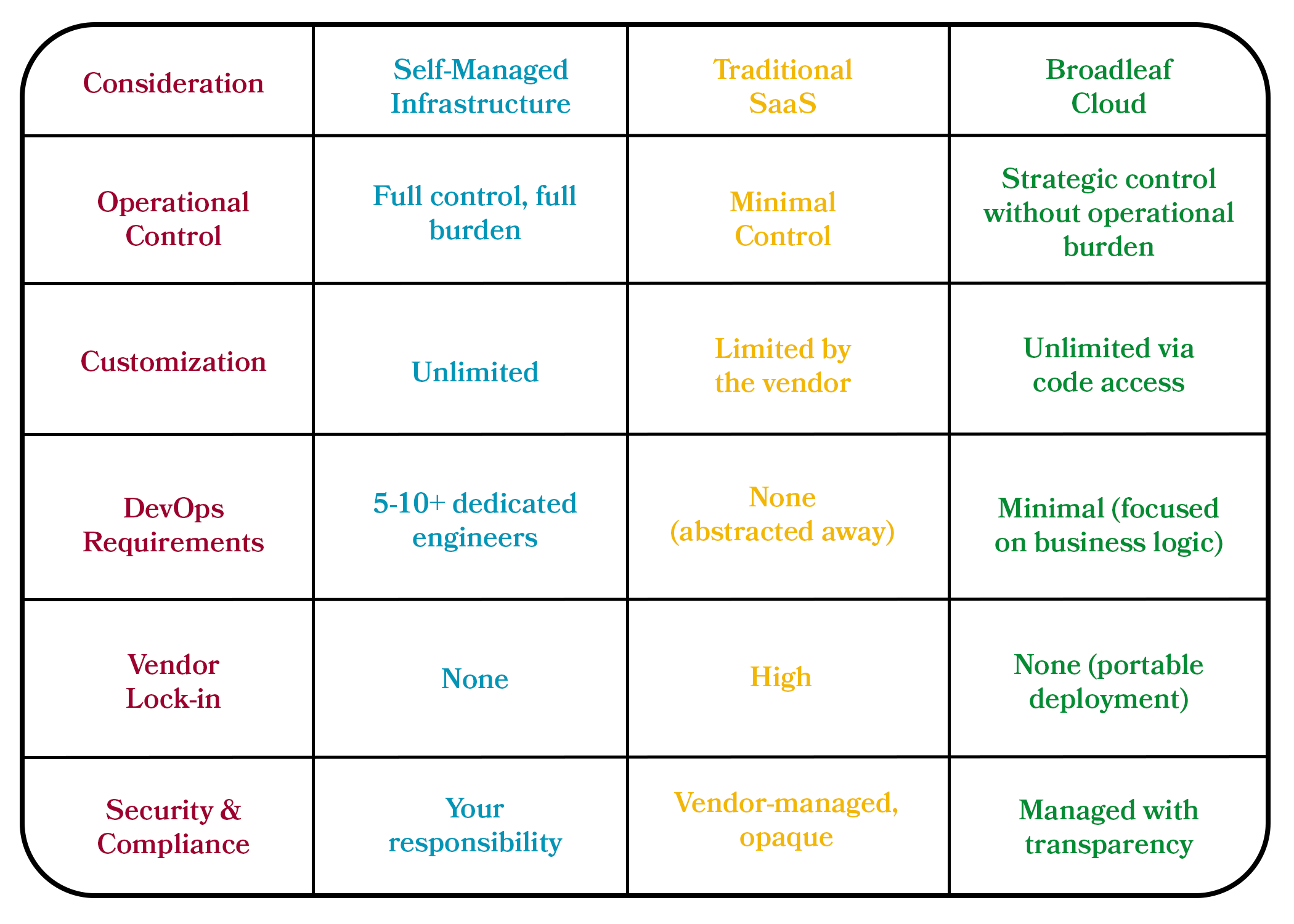
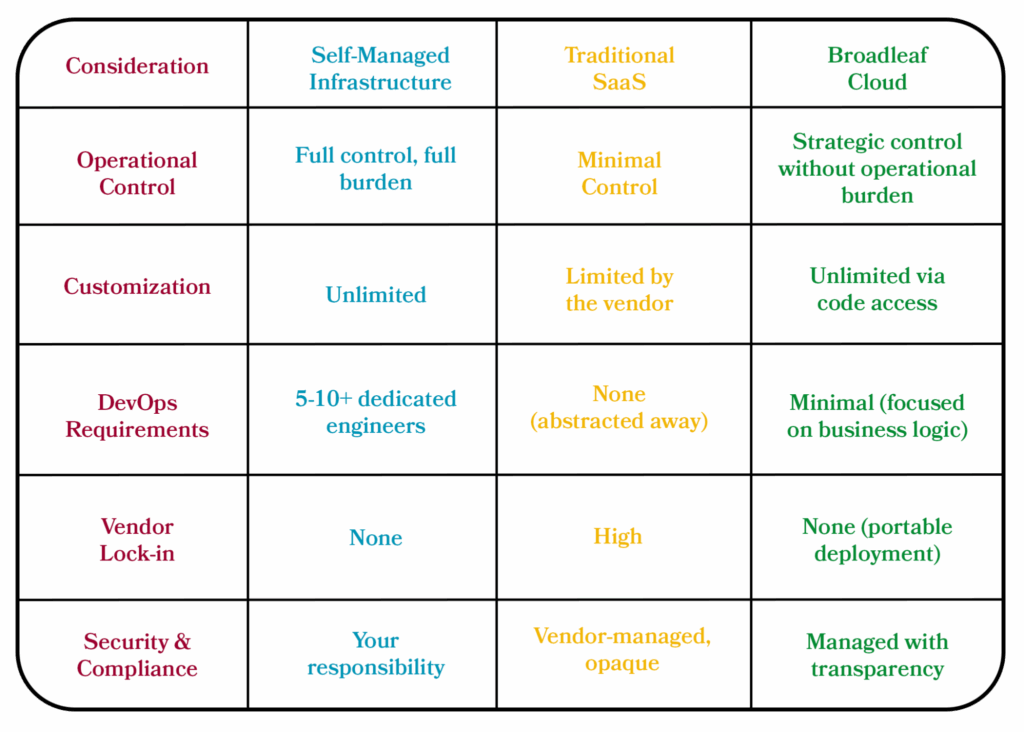
Microservices should accelerate your business, not consume your engineering budget. Choosing the right platform for modern commerce means balancing architectural flexibility with operational sanity. Self-hosting a microservices architecture provides absolute control but demands a massive, non-differentiating operational investment. Traditional SaaS sacrifices control and customization for convenience.
Broadleaf Cloud offers a strategic middle ground: a powerful, highly extensible platform built on Java and Spring, coupled with a fully managed environment that removes the operational burden. It's an approach that respects your developers' time, safeguards against vendor lock-in, and provides the production-grade stability, security, and scalability that complex enterprise commerce demands.
Ready to Reclaim Your Engineering Capacity?
It's time to let your team focus on commerce innovation, not container orchestration.
Get Started: Visit our contact page to connect with our solutions architects and explore how Broadleaf Cloud can be the foundation for your next commerce transformation. We'll help you evaluate the total cost of ownership, align with your technical roadmap, and understand how our managed infrastructure can accelerate your development velocity.