Promotion Stacking Done Right: What Most Platforms Get Wrong
Written by
Cassandra Gaston
Published on
Apr 14, 2026
Your spring sale is live. Free shipping over $75. A 20% loyalty reward for returning customers. A category-level BOGO on clearance items. Each promotion made sense on its own. Then a customer combines all three on a single cart, and your 52% margin drops to 31%.
Nobody approved that discount. Nobody modeled it. The promotions just happened to overlap, and the platform let them stack without guardrails.
This is the promotion stacking problem that merchandising teams deal with constantly, and most platforms handle poorly. Not because stacking is inherently bad, but because the tools that manage it were built as afterthoughts.
Stackable promotions are one of the most effective tools in a merchandiser’s playbook. When a customer can combine a percentage-off deal with free shipping, or layer a loyalty reward on top of a seasonal offer, it creates a buying experience that feels personalized and generous. Done well, promotion stacking increases average order value, moves excess inventory, and rewards your best customers.
The problem is that “done well” requires precision that most commerce platforms don’t offer out of the box.
Research from Symphony Commerce points to discount stacking as one of the biggest sources of margin leakage in eCommerce. Many store operators don’t realize stacking is happening until they review their P&L weeks later. By then, the damage is done: customers have found and shared the combinations on deal-hunting forums, and your “controlled” promotion has become an open invitation to drain margin.
The core issue is straightforward. Promotion stacking without rules is just uncontrolled discounting. And uncontrolled discounting is the fastest way to train your customers to never pay full price.
Most commerce platforms offer one of two approaches to promotion stacking: either promotions can combine freely, or they can’t combine at all. Neither works for a merchandising team running real campaigns.
The “stack everything” approach is what causes margin blowouts. A sitewide 15% off combines with a category BOGO, a first-time buyer coupon, and a loyalty points redemption. Each promotion was designed and approved independently. Nobody modeled the compound effect. This kind of unintentional overlap is the default behavior on platforms without explicit stacking controls.
The “nothing stacks” approach solves the margin problem but kills the customer experience. You built a loyalty program to reward repeat buyers, but they can’t use their points during a sale? That’s not a promotion strategy. That’s a way to make your best customers feel punished.
What merchandising teams actually need is granular control: the ability to define which promotions can combine with which, in what order discounts apply, and where the floor is. Most platforms bury this logic in custom code. If your team can’t set stacking rules without filing an engineering ticket, you don’t have a promotion engine. You have a promotion request system.
What margin erosion from bad stacking actually looks like
The math on uncontrolled promotion stacking gets ugly fast.
Consider a straightforward scenario. You sell a product at $100 with a 50% margin. You run three promotions that a customer qualifies for:
- 15% off sitewide (spring sale)
- Buy 2, get 10% off (volume incentive)
- Free shipping (threshold met)
Individually, each promotion is defensible. The spring sale moves seasonal inventory. The volume incentive lifts AOV. Free shipping reduces cart abandonment. But when they stack, the customer pays roughly $76.50 before shipping costs you absorb. Your margin drops from 50% to under 35%. Multiply that across thousands of orders, and the quarterly impact is significant.
This isn’t hypothetical. eCommerce operators have reported margins dropping 2-3% per quarter when stacking combinations go unmanaged. The damage compounds because deal-savvy customers share stacking strategies online, turning a promotional edge case into a widely exploited loophole.
The kicker: 83% of online users report using discount codes even when they would have purchased at full price. Every uncontrolled stack is free margin you gave away for a conversion that was already going to happen.
A discount stacking strategy that works requires more than “allow” or “deny.” Here’s what your promotion rules engine should let your team control without engineering involvement:
Combinability rules at the promotion level. Each promotion should have explicit settings for what it can and cannot combine with. Not just “stackable” or “exclusive,” but specific: “This BOGO can stack with free shipping but not with percentage-off offers.” This level of control is what separates a rules engine from a feature checkbox.
Priority and order-of-application logic. When two eligible promotions apply to the same item, which one goes first? A percentage discount applied before a fixed-amount coupon yields a different total than the reverse. Your platform should let merchandisers define this explicitly, not leave it to whatever the system defaults to.
Margin floors and guardrails. If stacked discounts would push an item below a minimum margin threshold, the engine should either block the combination or flag it for review. This is the single most important safeguard against the compounding effect described above. Without it, every promotion is a potential margin leak.
Customer segment controls. Loyalty members might get to stack offers that new customers can’t. VIP tiers might unlock combinations that standard accounts don’t see. Your stacking rules should reflect your customer strategy, not apply uniformly across your entire base.
Scheduling and approval workflows. Before a new stackable promotion goes live, someone should review how it interacts with every other active offer. Your platform should surface those conflicts during setup, not after launch.
If your current platform requires custom development for any of the above, you’re operating with a structural gap. As we covered in Why Promotion Strategies Keep Failing, the bottleneck isn’t your team’s strategy. It’s the tooling that sits between the plan and the execution.
Broadleaf’s Merchandising Suite was built around the assumption that promotion stacking is the norm, not the exception. The platform ships with combinability and stackability rules as a core capability, not a bolt-on.
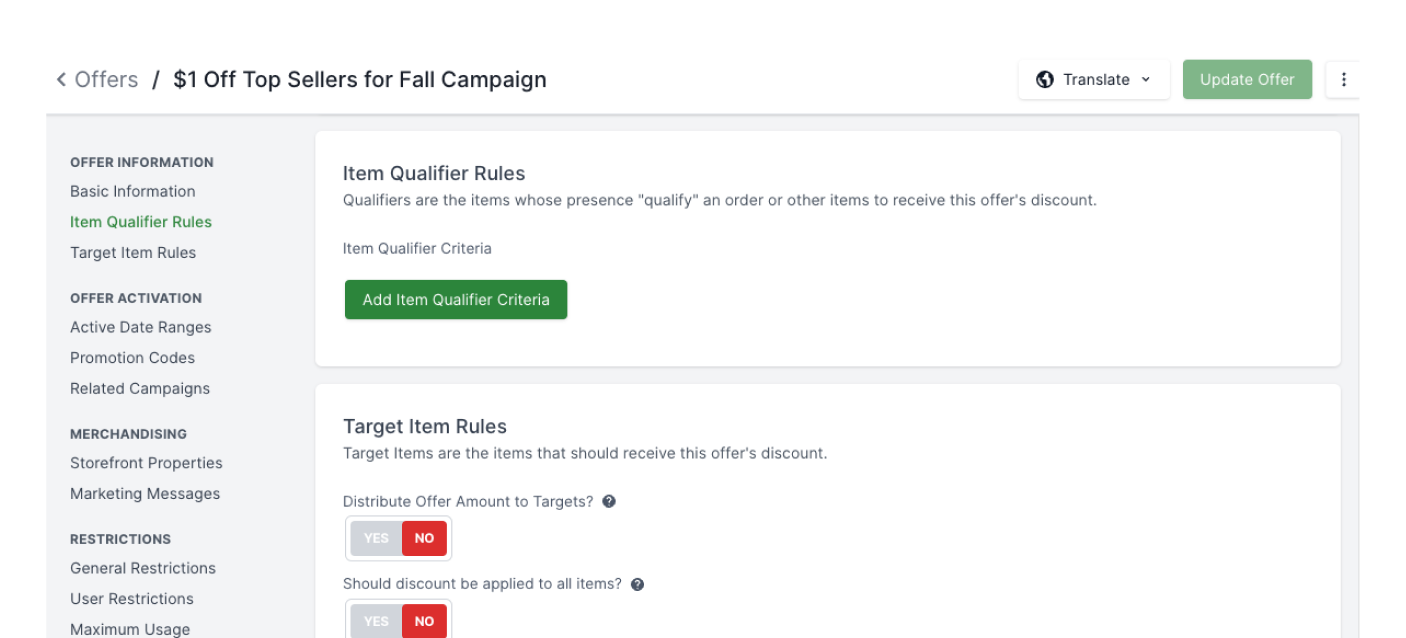
What that means in practice: your merchandising team defines offer types (order-level, item-level, shipping-level), sets combinability rules per offer, configures priority ordering, and publishes promotions through an approval workflow. No code changes. No deploy. No engineering ticket.
The engine supports percentage-off, amount-off, fixed-price, Buy X Get Y, tiered (“buy more, save more”), bundle offers, vouchers, single-use coupons, and limited-use promotions. Each of these can be targeted by customer segment, product, category, geography, or date range, and each has explicit stacking rules that determine how it interacts with every other active promotion.
Because Broadleaf is source-available, teams that need custom promotion types can extend the engine at the rule level. When your business invents a new offer structure, say a loyalty multiplier that varies by product category, your engineering team builds it on the platform rather than working around it.
Broadleaf’s guide to using promotions to boost your bottom line goes deeper on the strategic side of this: which promotions to stack, when stacking helps, and how to measure whether your stacking strategy is actually lifting revenue or just compressing margin.
Before your next platform evaluation, put these questions on the scorecard. The answers will tell you whether a vendor treats stacking as a first-class capability or a footnote.
Q: Can business users set promotion combinability rules without engineering?
A: If the answer involves “custom development” or “configuration files,” that’s a no.
Q: How does the engine resolve conflicts when two exclusive promotions apply to the same item?
A: Look for explicit priority ordering, not “it depends on which was created first.”
Q: Can we set margin floors that block or flag stacking combinations below a threshold?
A: If the answer is “you’d need to build that,” the engine is incomplete.
Q: Does stacking logic apply consistently across channels?
A: A promotion that stacks online but not in-store is a customer service problem waiting to happen.
Q: Can we model the margin impact of a new promotion before it goes live?
A: If you can only see the damage after launch, you’re testing in production with real revenue.
Q: How many promotion types work out of the box, and what does adding a new one require?
A: The gap between “supported” and “possible with custom work” matters more than the feature list.
These questions separate platforms that were designed for merchandising complexity from platforms that bolted on promotions as a feature checkbox.
Your promotions should be your competitive advantage, not your biggest margin risk. The difference comes down to whether your platform gives you control over how offers combine, or leaves that to chance.
Talk to a Broadleaf expert about how your team can take control of promotion stacking.
For how the underlying offer engine resolves stacking order, see The Engine of Commerce: A Developer's Guide to Broadleaf's Dynamic Pricing and Promotions.