Business

4 min read

Vibe Coding Is Breaking Your Commerce Stack. Here’s How to Fix It.

Brad Buhl

Written by Brad Buhl

Published on Apr 07, 2026

vibe coding
Hot mess express. That’s a fair description of where AI-generated code stands in commerce today. The explosion of Agentic Engineering has made it genuinely exciting to build again, but shipping fast on a shaky foundation is just tech debt with better PR.

The Velocity Vortex: Coding at the Speed of Light (and Liability)

The barrier to entry for custom dev has been demolished.
  • The Market Surge: The global Generative AI market is projected to leap from $103.58 billion in 2025 to $161 billion in 2026.
  • Agentic Adoption: By the end of this year, Gartner predicts 40% of enterprise applications will include task-specific AI agents, a massive jump from less than 5% just a year ago.
  • Developer Efficiency: Engineers are now using AI for roughly 60% of their workflow. We’ve moved past "vibe coding" (blindly accepting AI output) into a more structured orchestration of autonomous agents.

Security Shivers: When Your Silicon Sidekick Slights Your Safety

Now for the "say what?!" moment. While the code is flowing faster, it’s often arriving with some uninvited guests (vulnerabilities).
  • The Vulnerability Verdict: Recent audits show that 45% of AI-generated code contains security flaws, including command injection and hardcoded secrets.
  • Common Culprits: AI models are notoriously bad at "housekeeping." They fail to implement session management or proper password hashing in 35% of tests, and Cross-Site Scripting (XSS) has an 86% failure rate across models. (same proof here as the link above)
  • Systemic Risks: The International AI Safety Report 2026 warns that General-Purpose AI (GPAI) is actively being used by criminal groups to identify and exploit these very software vulnerabilities.
A brief glossary, then, to make sure we’re all on the same page:
Term Definition
Agentic Engineering The 2026 standard where humans orchestrate AI agents that autonomously plan, write, and test code.
Vibe Coding The "cowboy" 2025 approach of accepting AI output without reading the diffs—great for prototypes, terrible for production.
Shadow AI Unchecked AI tools used by teams without organizational oversight, leading to massive Technical Debt.
Security problems aren’t a reason to slow down. They’re a reason to build on better ground. That’s what platform architecture actually solves, and it’s where Broadleaf comes in.

The Broadleaf Blueprint: Foundation for Future-Proofing

Most eCommerce platforms make you bend your business to fit their product. Broadleaf flips that. It’s a framework, not a product, which means your team keeps control of the logic that actually matters:
  • Designed for Full Customization: Broadleaf is recognized as the only eCommerce platform specifically designed for full customization from the jump.
  • A Toolset, Not a Straitjacket: We provide a framework strategy—a comprehensive toolset—allowing you to create a custom product fit to your specific business needs.
  • Focus on the "Differentiation": While AI can churn out code, your real value lies in the "secret sauce" of your pricing logic, checkout flows, and account data.
  • Developer Velocity at Scale: Because our architecture is built on a modern Java stack like Spring Boot, your developers can embrace and extend the platform in days, not months.
Here’s what that looks like in practice, compared to a typical out-of-the-box SaaS product:
Consideration SaaS eCommerce (OOB-only) Broadleaf Framework (The Foundation)
Strategy Business process altered to fit technology. Technology adapted to fit business process.
Customization Configuration parameters with limited "extensible APIs". A modular framework allowing best-of-breed integration.
Innovation Stuck in a "one-size-fits-all" model. Ability to pivot and do something "un-thought of" by current standards.

Pragmatic Progress: Strangling the Security Risks

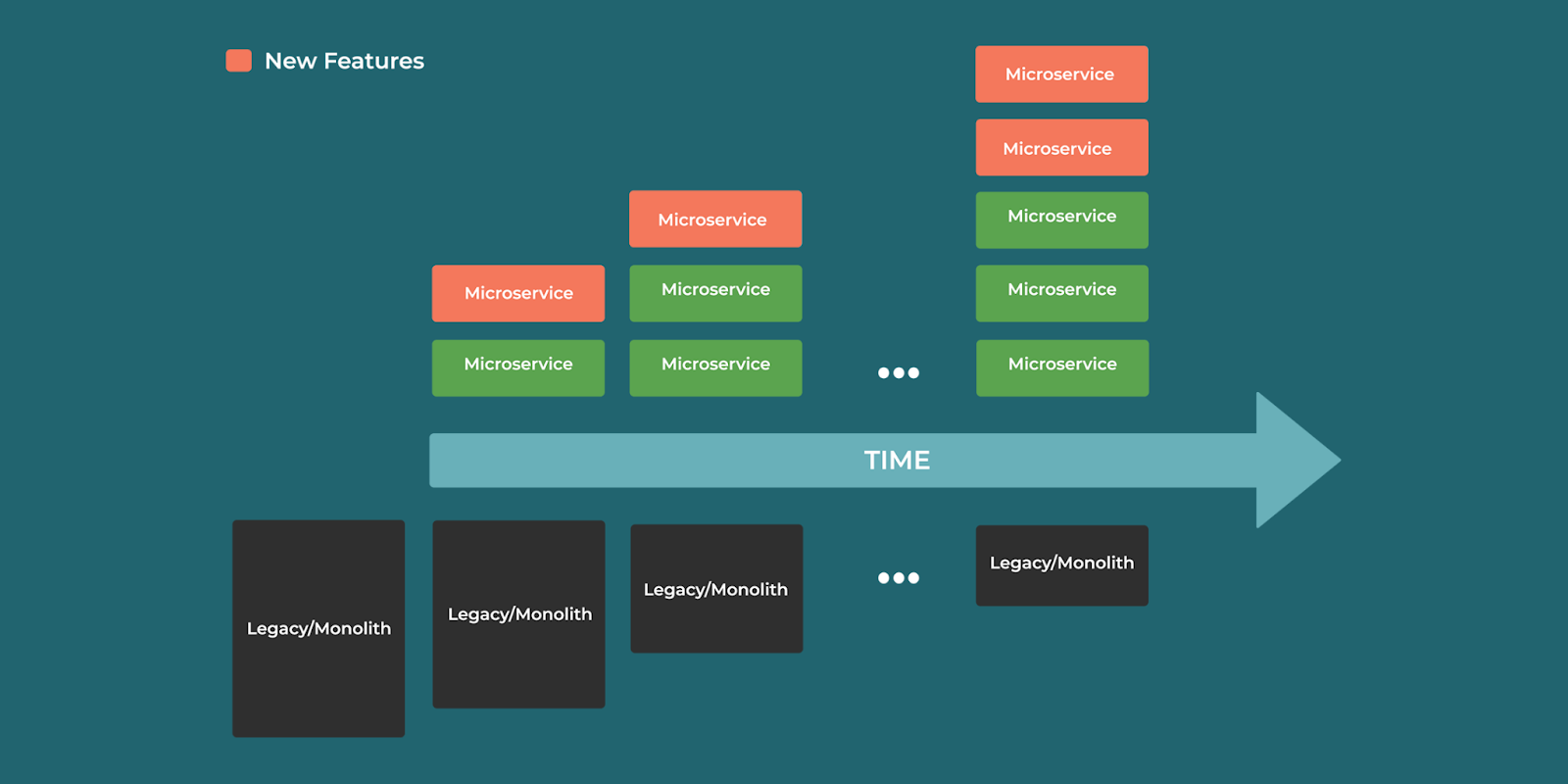
As custom dev increases at a rapid pace, the "big bang" migration is officially dead. We advocate for the Strangler Pattern, which allows you to surround and replace legacy systems incrementally.
  • Service-Based Evolution: Broadleaf allows you to isolate critical feature sets—like a brittle promotions engine—and replace them with API-driven services in months, not years.
  • Orchestration is the Secret Sauce: In a GenAI-heavy environment, modular commerce only works if it is orchestrated well.
  • Shared Data Flows: We enable modular service rollouts while maintaining the synchronized communication and shared data flows required for a unified customer experience.
The result is a commerce stack that doesn’t fight your AI tooling. It works with it, letting you ship new capabilities without pulling threads on everything else. ecosystems that deliver value today and remain adaptable tomorrow. With the code-generation bots running 24/7, are you seeing your team struggle more with "integrating" the new code into your legacy stack, or is the "housekeeping" of that code the bigger headache? Whichever it is, Broadleaf was built for exactly that. Want to see it in action? Grab some time with our team, and we’ll walk you through it.

Related Resources