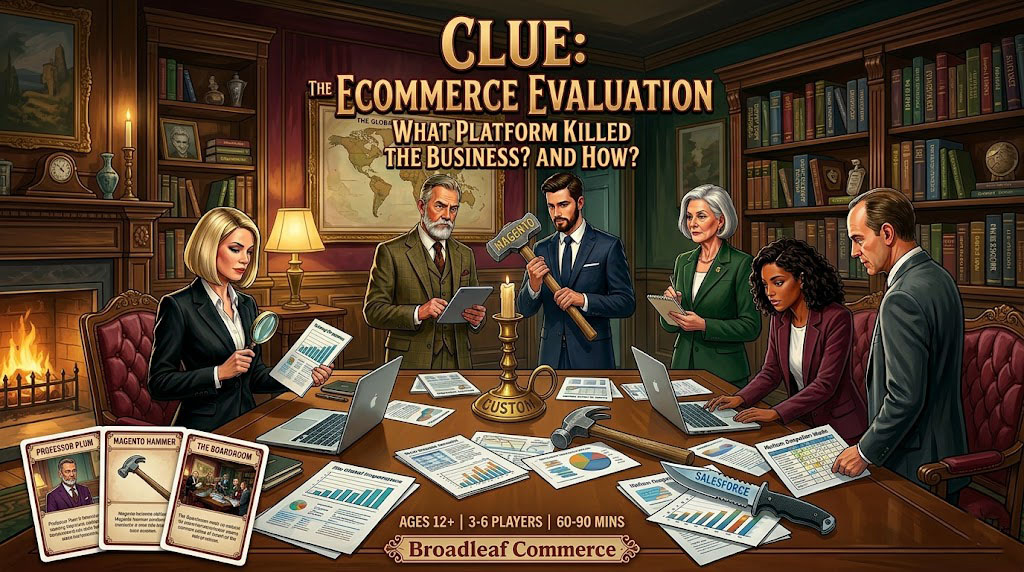
Enterprise eCommerce: Navigating the Platform Paradox
Written by
Brad Buhl
Published on
Mar 18, 2026
Across industries, the eCom landscape has officially shifted from "Omnichannel is cool" to "Unified Commerce or Bust," and the technology debt from the last decade is finally coming due.
Between Agentic AI doing your shopping for you and the "Strangler Pattern" becoming a standard architectural survival tactic, choosing a platform is no longer just an IT checkbox—it's a strategic survival move.
Key Takeaways: The Quick and Dirty
- Unified over Unique: Siloed systems are the #1 barrier to growth; if your online and offline systems don't talk, your customers won't either.
- AI is the New Architect: We’ve moved past chatbots; 2026 is about "Everyday AI" helping merchandisers predict margins and "Agent AI" automating the boring bits of the supply chain.
- Composability is a Cost Trap (Unless...): Managing 30 different SaaS logins is an operational nightmare. You need a central hub to orchestrate the chaos.
- Flexibility is the Ultimate Currency: If you can’t adapt your technology to your business process, you’re just paying rent on a digital prison.
What Enterprises Actually Want in 2026
In a world where "Composable" has often become code for "Complicated," enterprise leaders are ditching the hype for three specific pillars:
- Orchestrated Composability: They want the modularity of microservices without the "Tangle of Tech" that comes from managing 12 different administrative interfaces.
- Deployment Freedom: Whether it’s on-premise for high-security, in their own cloud for control, or a SaaS-like experience, "SaaS-only" is a dealbreaker for many (common phrases here are data & digital sovereignty).
- Predictable Pricing: CFOs are tired of "Success Taxes" (revenue sharing) and unpredictable usage fees. They want to own their destiny—and their license. Not to mention the fact that Agentic Commerce is going to absolutely drown companies in usage-based fees.
The Great 2026 eCommerce Breakdown
1. The "Cloudy" Classics: Legacy On-Prem Solutions
These are the heavy hitters from the Y2K era trying to put a fresh coat of "Cloud" paint on monolithic foundations.
- The Suspects: SAP/Hybris, Oracle/ATG, IBM/HCL.
- Where They Fit: Organizations with massive, existing investments in a specific ecosystem (like SAP or Oracle) where the "gravity" of their data and back-office integration makes a slow, steady migration more palatable than a risky "rip and replace".
- The Rub: They’re profoundly entangled with legacy processes, making them "safely" impossible to upgrade.
- Broadleaf vs. The Monolith: While they offer stability, we offer the Strangler Pattern. We allow you to "strangle" the brittle parts of your legacy system—like a promotions engine—and replace them incrementally with modern APIs without a "Big Bang" failure.
2. The "Locked-In" Legends: Legacy Enterprise SaaS
The "safe" choice for the last decade, now feeling the weight of their own rigid architectures.
- The Suspects: Salesforce/Demandware, Adobe/Magento.
- Where They Fit: Businesses that want a "safe," battle-tested partner with a massive global footprint and a pre-built ecosystem of plug-and-play apps, allowing you to focus on marketing rather than managing server uptime.
- The Rub: You’re often stuck in a "One-Size-Fits-All" box. If you want to customize the back-end admin or integrate a unique 3PL flow, you’re hitting a SaaS wall.
- Broadleaf vs. Legacy SaaS: We provide the "Extensible Alternative." While they give you a product, we give you a Framework. You get the scale of the cloud with the ability to open the "hood" and customize any business logic you need.
3. The "Scattered" Specialists: Composable SaaS Solutions
The darlings of the MACH movement that occasionally forget that someone actually has to manage the plumbing.
- The Suspects: CommerceTools, VTEX, Spryker, ElasticPath.
- Where they fit: Highly mature technical teams that want to build a "Best of Breed" stack from the ground up, picking the absolute best search, best cart, and best CMS to create a truly unique and decoupled customer experience.
- The Rub: Composability becomes a burden when you have 15 vendors, 15 security audits, and 15 data silos.
- Broadleaf vs. Composable SaaS: We believe in Sanity over Sprawl. Our microservices are "Modular with Orchestration." You get the modularity you want but with a Unified Admin to keep your merchandisers from losing their minds.
4. The "Play-Up" Pretenders: SMB SaaS trying to "Go Pro"
Great for selling socks; occasionally shaky when trying to manage complex B2B dealer networks or multi-brand portfolios.
- The Suspects: Shopify Plus, BigCommerce.
- Where They Fit: Brands that prioritize extreme speed-to-market and simplicity, offering a low-barrier entry with beautiful templates that allow a business to go from "idea" to "selling" in a matter of days without needing a single developer.
- The Rub: They are consumer-oriented, not service-oriented. Their "extensible APIs" are usually just for the front-end, leaving your back-office operations feeling like a "Wrestling Match".
- Broadleaf vs. SMB SaaS: When your business grows out of "Tactical" and into "Strategic," you need Broadleaf. We handle the "Multi-Everything"—multi-brand, multi-currency, and multi-channel—without hitting the limitations of a template-driven world.
5. The "Do-It-Yourself" Danger: Custom Build
The ultimate in control, usually followed by the ultimate in technical debt.
- The Option: Building from scratch.
- Where They Fit: Companies with truly "outside the box" business models or proprietary intellectual property where no existing software on the market can possibly accommodate their unique competitive advantage.
- The Rub: You’re essentially building the "plumbing" (carts, tax, checkout) instead of focusing on the "porch" (your actual brand differentiators).
- Broadleaf vs. Custom: Why build the foundation when we’ve already built the best-in-class Enterprise Framework? We give you the "Reins and the Roadmap," so your developers can focus on innovation instead of reinventing the "Add to Cart" button.
How Broadleaf Can Help You Conquer the Complexity
At the end of the day, I’m biased—but for good reason. Broadleaf is the only platform designed for Full Customization that doesn't force you into a vendor lock-in or a technical debt trap.
- Own Your Strategy: We adapt the technology to your business process, not the other way around.
- Deployment Flexibility: Whether it’s on-premise, in your private cloud, or ours, we provide the highest deployment flexibility—and licensing that keeps costs predictable.
- Future-Proof Your Investment: With our modular architecture, you can start small (like modernizing your Cart) and scale as your vision grows.
Ready to move your eCom platform from surviving to thriving?