Promotional Integrity: Why Accuracy Matters in Stacking Discounts
Written by
Sunny Yu
Published on
Jun 02, 2026
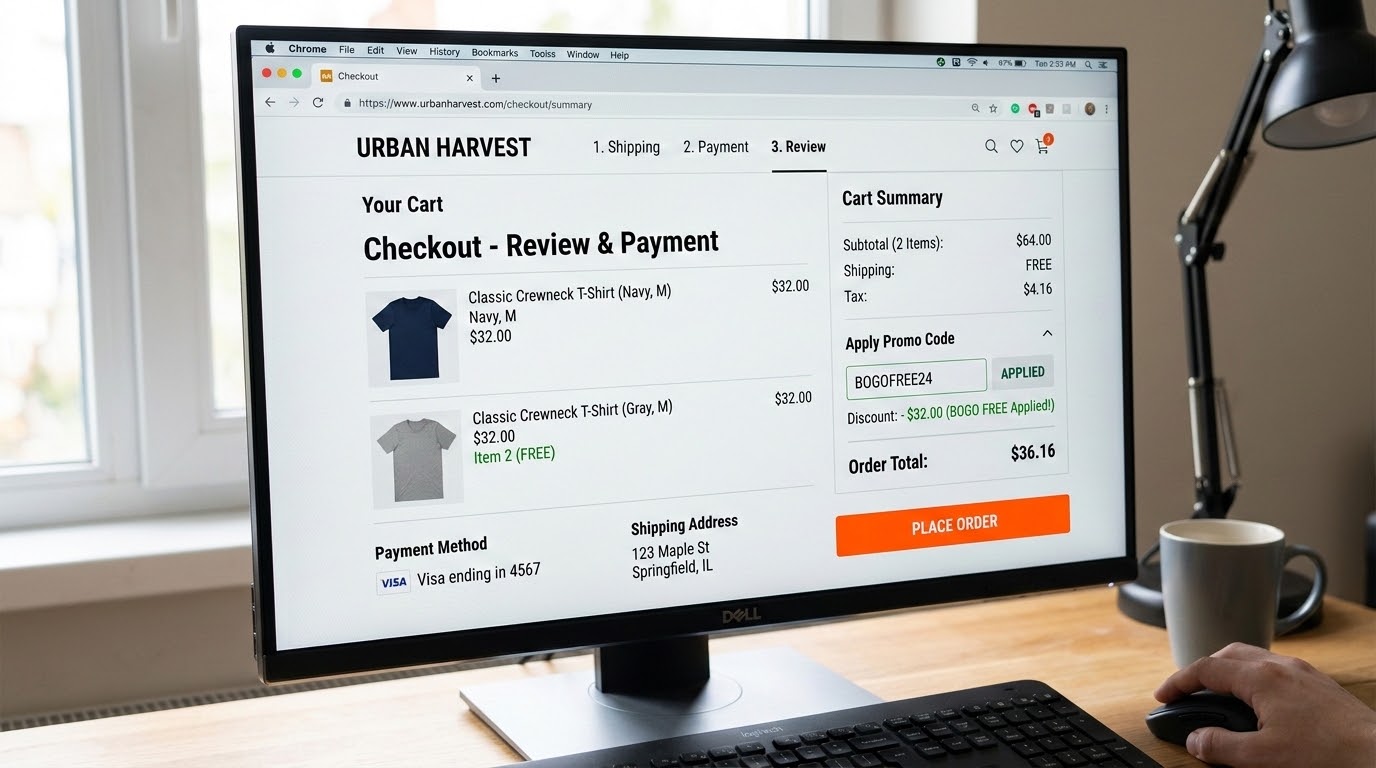
In the competitive world of retail, promotions are a primary driver of customer loyalty and conversion. From "Buy One, Get One" deals to "5% Off" coupons, shoppers have come to expect a seamless and fair experience at checkout. However, behind the scenes, the math required to stack those discounts accurately is anything but simple.
A recent enhancement to the Broadleaf Promotion Engine highlights a common challenge in digital commerce: the "Prior-Discount Blind Spot." While the bug was subtle, the consequences at scale were not. In high-volume checkouts, even a fractional miscalculation per line item compounds into thousands of customers seeing less savings than promised. The result is a measurable hit to conversion and to brand trust.
The Challenge of the "Max Savings" Cap
Retailers often use a feature called a Maximum Savings Cap. This allows a brand to offer a generous discount (like 10% off) while setting a safety net (like "up to $50 total") to protect their margins.
When a customer buys multiple items, the promotion engine must calculate the savings for each item until it hits that $50 cap. The calculation seems simple—until you start stacking multiple promotions on top of each other. The cap is a quiet workhorse. It lets marketing teams run aggressive offers, sometimes 15%, 20%, or even 30% off, without finance teams worrying about runaway exposure on high-ticket carts. But the cap only works if the engine evaluating it has a complete picture of what the customer has already saved. The moment a second offer enters the calculation, the math gets harder, and so do the failure modes.
The "Prior-Discount" Blind Spot
The "Blind Spot" occurs when a product has already been discounted by one offer before a second, capped offer is applied.
Imagine a customer is buying a specialized item originally priced at $3.50.
- First, a high-priority "Fixed Price" sale drops the item to $2.75.
- Next, the customer applies a "5% Off" coupon that has a $1.50 Max Savings cap.
The Logic Error
If the system is "blind" to the first discount, it calculates the 5% savings based on the original $3.50 price. It thinks the customer is saving more per item than they actually are. Because it thinks the savings are higher, it triggers the $1.50 "savings cap" much too early. The problem is not that the engine made a mistake, but that it was answering the wrong question. It was asked "what is 5% of this item," and it faithfully returned a number based on the price the item started at. By the time that calculation ran, the item no longer cost $3.50. The Fixed Price offer had already moved it to $2.75, and any savings calculation tied to the original MSRP was, by definition, overstated. At one item, the gap is six cents. Across a cart of twenty units, it is enough to misfire the cap and short-change the customer by real dollars.
The Result for the Customer
The customer is told they’ve reached their maximum savings limit before they actually have. They end up receiving less of a discount than they were promised, which can lead to frustration, abandoned carts, and a loss of brand trust.
Ensuring a Fair Checkout
Broadleaf has addressed this by ensuring the Promotion Engine is "stack-aware." Instead of looking at the price a product started at, the engine now evaluates the price as it exists at that specific moment in the calculation. Under the hood, this meant updating OfferEngine's adjustment models so that the currently adjusted running price is explicitly injected into the remainder calculation, rather than inferred from the line item's original state. The engine now evaluates every offer against the price as it exists at that moment in the calculation. Not what the product started at, not what marketing originally listed it at, but what the customer is actually paying right now. It is a small change to the contract between offers and the engine, and a meaningful one for accuracy.
By accounting for every discount already applied to the item, the engine can accurately track how much the customer is truly saving. This ensures that:
- Customers get exactly what is promised: No one is "short-changed" by a math error.
- Promotions are transparent: The logic at checkout matches the marketing on the storefront.
- Retailers stay protected: The "Max Savings" cap still works perfectly—it just triggers at the correct moment.
Conclusion
In modern eCommerce, the "Last Mile" of the customer journey is the checkout. Precision in that moment is vital. By eliminating the prior-discount blind spot, Broadleaf ensures that retailers can run complex, multi-layered promotions with total confidence that the math will always favor a fair and accurate customer experience. And as merchants layer in increasingly sophisticated promotion strategies, loyalty multipliers, segment-specific offers, dynamic markdowns, that stack-awareness becomes the foundation everything else builds on.This resolution was part of the PromotionServices 3.2.0 update, which is included in the full Broadleaf Microservices 2.3.0 release.