Why Deployment Flexibility Matters for Commerce
Written by
Cade Rea
Published on
Jul 22, 2025
Everyone talks about microservices like they're magic. But here's the thing most people miss: breaking your platform into multiple microservices doesn't automatically make your life easier.
The era of rigid, monolithic commerce platforms is coming to an end, and flexible architectures are emerging as the new standard. For software developers and architects, this shift isn't about chasing the latest buzzwords. It's about getting absolute control over how you deploy and scale your systems.
Why Flexibility Matters
I've worked with enough enterprise development teams to know that deployment flexibility isn't just a nice-to-have feature; it's become a competitive necessity. When your platform can't adapt quickly, you watch opportunities slip away while your competitors move faster.
For developers, this flexibility means faster iteration cycles, independent service deployments, and a significant reduction in technical debt. I've seen too many talented teams burn out wrestling with monolithic constraints when they should be building cool stuff. With Broadleaf, you can finally break free from these constraints and focus on what you do best: creating innovative solutions.
For business stakeholders, this technical flexibility directly impacts your bottom line. Faster time-to-market for new features, less risk during platform updates, and the ability to respond quickly when competitors make moves. When Black Friday traffic spikes unexpectedly or a rival launches something game-changing, you want a platform that can pivot without requiring a complete rebuild.
How Broadleaf Actually Works
So what makes Broadleaf different? We built our platform with freedom and extensibility in mind from the ground up. We're not just throwing around "composability" as a marketing term. We mean it.
Broadleaf's architecture uses over 30 microservices, each designed to work independently. Think of it like a toolbox, where each tool has a specific job, but you can use them individually or combine them as needed for your project. Catalog management, order processing, and inventory - they can all be managed and scaled separately.
And if you're worried about vendor lock-in (you should be), Broadleaf is cloud-agnostic. Deploy on Broadleaf Cloud, Google Cloud, Azure, or your own infrastructure. Our platform's cloud-native design supports your efforts in building cross-data center deployments for disaster recovery, recognizing that downtime costs money, and nobody has time for that.
If you're working in Java and Spring, Broadleaf speaks your language. Our platform is built on the Spring Framework, including Spring Boot and Spring Cloud. This wasn't random - Spring's mature ecosystem and JIT compilation work great for high-volume transactions and complex business logic.
The Spring ecosystem also makes service creation and API development straightforward, with built-in support for RESTful APIs, as well as integration with cloud providers and messaging systems.
One feature that matters for maintainability: we use @ConditionalOnMissingBean for our framework components. If you provide a custom implementation, our default is automatically disabled, and yours takes over. Your teams write new code that layers cleanly on top of base Broadleaf modules, making upgrades way less painful.
Deployment That Makes Sense
This is where things get practical. Broadleaf goes beyond just offering microservices. We provide deployment strategies that align with your team's reality, taking into account your operational maturity, budget, and the number of people you need to manage.
Our architecture does "true" composability, meaning every microservice can be deployed separately or together. But we realized that managing 30+ individual microservices can be overwhelming, especially if you don't have a massive DevOps team. That's where Flex Packages come in.
A Flex Package bundles multiple microservices together into a single executable JAR. This reduces the overhead of managing numerous individual microservices, shrinks your cloud footprint, and simplifies DevOps complexity. All while keeping proper bounded contexts and design boundaries intact.
We offer three Flex Package options:
- Balanced Composition is what we recommend for most enterprise teams. It groups microservices into four main components: Cart, Browse, Supporting, and Processing. This lets you run smaller infrastructure deployments that would be tedious with individual microservices. Most teams find that this hits the sweet spot between flexibility and manageability.
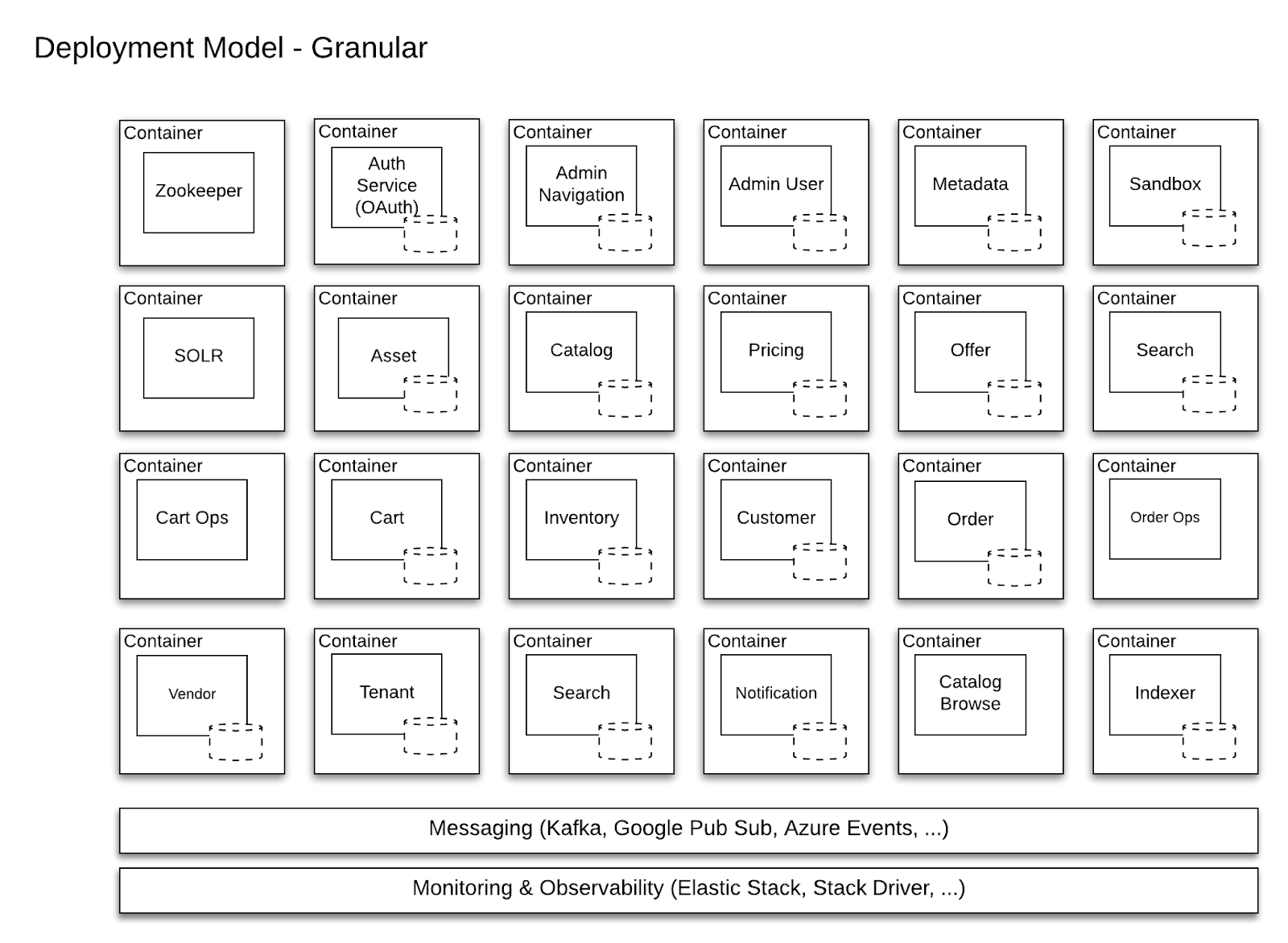
- Granular Composition is designed for large organizations with specific needs, complex implementations, and mature DevOps teams. If you have the personnel and infrastructure to manage individual microservices independently, this provides you with maximum control over scaling and maintenance. With Broadleaf, you're in the driver's seat, able to tailor your deployment to your exact requirements.
- Mono Composition is mainly for local development and evaluation. It combines most microservices into a single deployable unit, making local development simpler and helping developers understand the entire ecosystem without juggling multiple services on a single machine. With Broadleaf, you can develop in a comfortable, straightforward environment, without the complexity of managing multiple services.
The powerful part? You can combine microservices into custom configurations or break them apart into granular pieces just through configuration. This lets you model your infrastructure to match your revenue growth or team culture. Start simple and scale when needed.
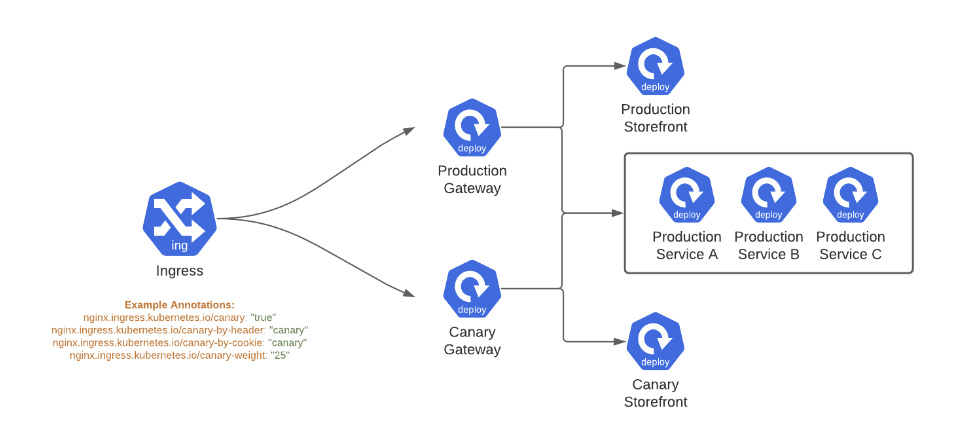
Broadleaf's modularity also supports the Strangler Fig Pattern for migrations. Instead of a risky "big bang" replatforming that keeps everyone up at night, this approach lets you gradually replace legacy functionality with new microservices. You can select specific domains, such as pricing or promotions, and build new services around your existing systems. Then, you can gradually route traffic to the modern components as they stabilize. This minimizes risk, lets you prove ROI early, and keeps your team focused on outcomes rather than massive architectural changes.
Why This Matters
Broadleaf's deployment flexibility works for both development teams and business stakeholders. By providing a microservices architecture built on Java and Spring, along with deployment options such as Flex Packages, you can quickly adapt to market changes, optimize infrastructure costs by tailoring your deployment footprint, and accelerate innovation through independent services.
If you're looking for a commerce platform that gives you absolute control and flexibility, and a clear path to future-proof your digital commerce strategy, Broadleaf is worth checking out. It's time to choose a platform that aligns with your vision, rather than working against it.
For how source-available access connects to deployment flexibility specifically, see What Is Source-Available Commerce for Enterprises.